
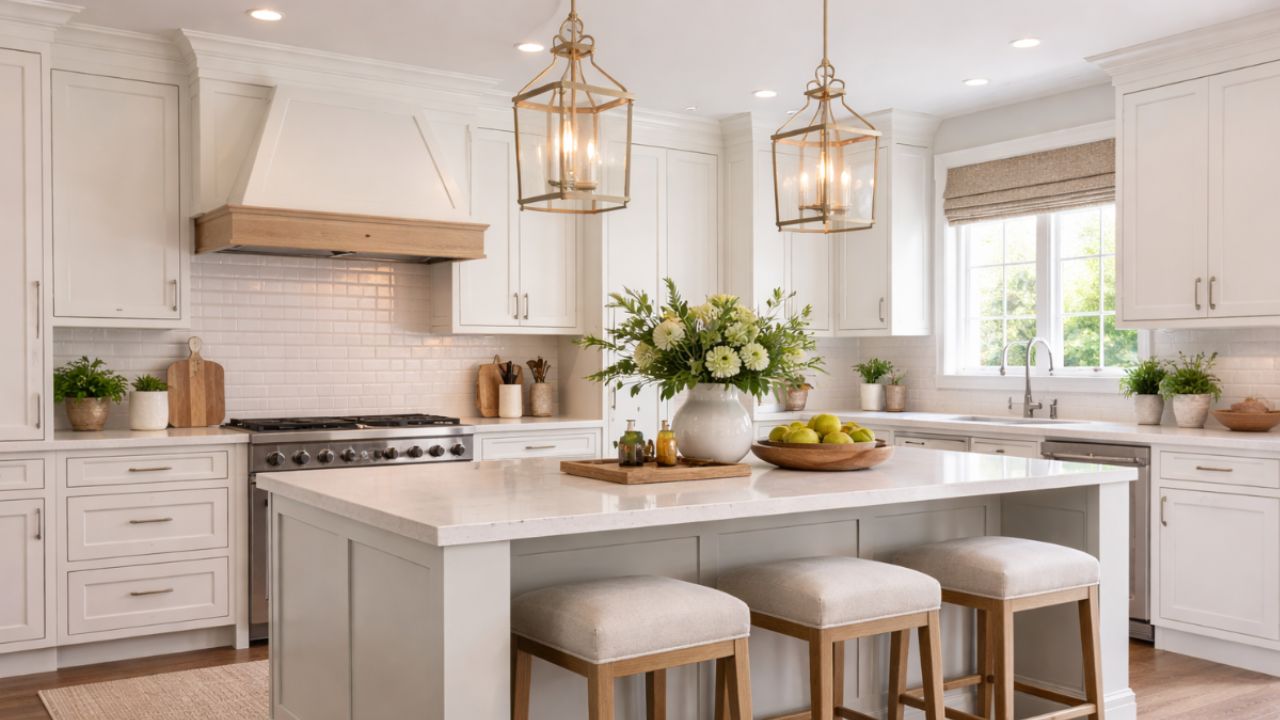
Some kitchens age poorly. Others move through decades with the same elegance with which they were designed. The difference rarely lies in following trends, but in making fundamental choices that withstand time, fleeting fashions, and everyday use.
+ The most important part of your home to clean every night to maintain organization
A truly timeless kitchen design does not try to impress at first glance. It works, it welcomes, it makes sense — today and twenty years from now.
Here are the five points these projects always get right.
1. Layout designed for real use, not for the photo
Timeless kitchens start with the basics: intelligent flow. The positioning between sink, stove, and refrigerator — the classic work triangle — continues to be one of the most consistent pillars of functional design.
When the layout respects the real routine of the household, the kitchen remains practical regardless of aesthetic trends. Well-proportioned islands, comfortable circulation areas, and sufficient work surfaces ensure the space stays current because it remains useful.
Functionality never goes out of style.
2. Honest materials that age well
Timeless projects avoid finishes that are overly “dated” or too synthetic. Instead, they rely on natural or visually honest materials, such as:
- Natural stone or discreet-looking quartz
- Wood in medium or light tones
- Brushed or satin-finished metals
- Ceramic and porcelain with a soft texture
These materials not only withstand physical wear, but also gain character over time — something overly glossy or artificial surfaces rarely achieve.
3. Balanced color palette, never too literal
Timeless kitchens rarely depend on “on-trend” colors. Instead, they build a neutral base — white, off-white, warm gray, beige, natural wood — and let personality emerge in the details.
This does not mean an absence of color, but strategic use: a deeper tone on lower cabinets, a subtle accent wall, or metals in warm tones. This way, the space can evolve without requiring a complete renovation.
The secret is allowing targeted changes without compromising the whole.
4. Simple cabinetry with correct proportions
Timeless design almost always succeeds through simplicity in cabinetry. Flat-front doors, subtle frames, or lightly detailed panels tend to stand the test of time better than overly ornate styles.
More important than the style itself is proportion: well-defined heights, precise alignments, and harmonious integration with appliances. When cabinetry respects the architecture of the space, it never looks outdated — just well resolved.
5. Layered lighting thoughtfully planned
No timeless kitchen relies on a single light source. Long-lasting designs combine general, task, and decorative lighting.
Recessed fixtures provide even illumination, LED strips under cabinets make food preparation easier, and well-chosen pendants add identity without excess. When lighting enhances the space without stealing the spotlight, it remains relevant for decades.
Well-planned lighting transforms even the simplest design.
What they all have in common
Timeless kitchens do not try to look modern all the time. They prioritize coherence, comfort, and quality. They are spaces that function before they impress — and precisely for that reason, they remain current.
In the end, the design that never ages is the one that understands that living well will always be in style.
This content was created with the help of AI and reviewed by the editorial team.
